


A well-functioning team – what is it, and how do you build one?
A well-functioning team is crucial for both performance and employee wellbeing. But what actually makes a team work well? This article gives you the tools to better understand your team, so you know what to pay attention to when working with a team made up of different personality types.
What is a well-functioning team?
A well-functioning team is a group of interdependent people with shared goals, clear role distribution, and mutual responsibility for results. The most common reason teams fail is poor communication and collaboration. Building a well-functioning team requires structured preparation, targeted development activities, and consistent follow-up — according to Robert Brinkerhoff's 40-20-40 model, preparation and follow-up each account for 40% of a development initiative's success, while the activity itself accounts for only 20%.
Learn more about:
Why is it important with well-functioning teams?
As people, we are different. We have different personalities and different ways of working. When a team is not functioning well, the most common reason is that collaboration and communication within the team are not working.
It is essential that all team members accept and understand each other’s differences. Well-functioning teams matter for team longevity, productivity, and success, which is why it is the leader’s responsibility to stay alert to potential or actual issues within a team and act on them.
What is a team?
The definition of a team is that the members of a group are interdependent. It is a group of people with professional working relationships who are able to respond as a unit.
A team can make use of the individual resources each employee brings, and its members can inspire and support one another.
In modern working life, most of us will experience working in more or less formal team structures. Some teams are short-lived and exist only for the duration of a project, while others, such as a departmental team, are longer-lasting with formal and fixed structures.
A team is brought together to solve specific tasks and works towards a shared goal, whether that goal is short-term or long-term.
Unlike a working group or project group, which is more loosely connected, a permanent team is more closely bonded and has greater insight into one another.
What is a successful team?
Few leaders do not want a well-functioning team. If the team works well, it will also be more effective. That benefits both the organisation and the team members themselves.
There are certain characteristics that define a successful team:
- Shared goals
- Clear role distribution
- Shared responsibility for results
- Commitment to achieving common goals
- Mutual dependence on one another
- Individual success equals team success
- Use of each others skills and resources
- Acceptance of each other’s strengths
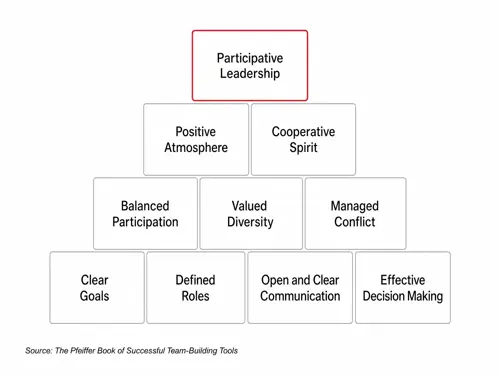
The model below shows the factors that need to be in place for a team to be successful.
How do you build a well-functioning team?
At the bottom of row 1 are the boxes that form the foundation for the other boxes and which must be in place in the very early stages of a team. Row 2 is also essential in the early phase of a team, and these factors depend entirely on the basic foundation being present. Row 3 contains characteristics that make it satisfying for team members to be part of the team.
The top box in row 4, participative leadership, is the only box that can be removed without disrupting the others. This does not mean that leadership is not important, but in the early stages of establishing and developing a team, leadership is not essential to the team’s success. As the team matures, the leader can usefully step into the role of coach in order to create good conditions for development and thereby improve team effectiveness.
The 40-20-40 model improves team dynamics
There is no plug-and-play solution for improving collaboration and communication in a team. It requires willingness, motivation, and effort from all team members.
Many of us may have taken part in workshops that seemed to work well in the moment, but later lost impact because there was not enough follow-up or implementation. It can be incredibly difficult to change old habits and deeply rooted patterns.
It requires the new ways of working and thinking to be practised so many times that they eventually become integrated into how we act. That is why it is never enough to “just” hold a workshop or run analyses that highlight challenges within a team. Without the right follow-up, that effort can easily be wasted.
Put simply, there are three stages to focus on if a team is to move from dysfunctional to well-functioning:
- Preparation
- Workshops and analyses
- Follow-up and implementation
The American professor Robert Brinkerhoff has spent many years researching the effect of learning activities. He states that only around 15% of all competence development has a clear, measurable, and positive effect in the workplace.
Brinkerhoff developed the 40-20-40 impact model. This model shows where energy should be focused before, during, and after a workshop to achieve the best effect: 40% in the preparation phase, 20% during the workshop itself, and 40% in the follow-up phase — hence the name 40-20-40 model.
This shows, contrary to what many people might think, that preparation and follow-up are the factors that most strongly determine whether a workshop or development process is successful.
That is why it can be an advantage to run several shorter workshops, so there is an opportunity to work with what has been learned before meeting again.
In other words, the leader must first and foremost prepare thoroughly and set measurable goals for the team’s development. Then, all participants must be engaged in the workshop, especially in the implementation phase, and be ready to adjust things along the way.
Strengthen the team by understanding personality types
Would you like to strengthen your team and help it succeed? One way to do that is by testing team members and finding out which personality type each person is.
By using tests and personality types, you gain insight into how each person works, reacts, and communicates best. It can be a real advantage to know which types make up the team in order to build good communication and create an environment where everyone can thrive.
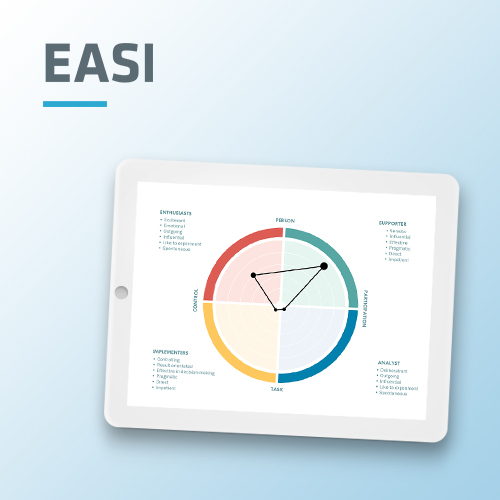
Master International's EASI typology test is highly suitable for team development, as it creates value by giving the team a shared language and a better understanding of differences. It measures both behaviour and motivation. The EASI typology test is a strong visual tool for employee development and can even be used during onboarding.
Once you understand which personality types are in your team, you can strengthen collaboration even further by exploring how each person behaves in online meetings — something that has become much more common in recent years.
Even though we are not physically present, our online behaviour also has a significant impact. The way we communicate, think, and react may differ online compared with in-person meetings. If we want to maintain strong collaboration, it is a good idea to understand both our own and others’ behaviour in online meetings.
EASI strengthens collaboration and provides MT Højgaard Denmark with a common language
At MT Højgaard Denmark, the objective was clear: to break down silos and strengthen cross-disciplinary collaboration. Part of the solution was the EASI typology.
What does diversity mean for your team?
There are both strengths and pitfalls in having a team made up of members who are very similar to each other, or a team made up of many different personality types.
Low diversity – many of the same type
In a team made up primarily or entirely of the same type, there will often be clear patterns. In many cases, the work runs smoothly and members may find it easier to work together. As a leader, however, you need to be aware that having too many people looking at a task in the same way can also be a disadvantage, because everyone shares the same perspective.
High diversity – many different types
A team made up of different types brings more perspectives to work tasks. It can also be a leadership challenge to manage several different types within the same group. Both communication styles and work processes will likely differ, which means there is a need for clear guidelines so everyone can work under the same conditions. Once those are in place, high diversity can be a real advantage, because different perspectives and competencies come into play.
It pays to have a well-functioning team
It can take hard work to build a well-functioning team, but there is value to be gained on the bottom line when everyone in the team is working at their best. It creates better wellbeing and delivers better results.
While you are working to develop and strengthen your team, it is also worth taking a closer look at your leader. The team leader is one of the driving forces behind a well-functioning team, which is why you should also focus on developing your leaders.
Want to try EASI typology?
EASI is a development tool that creates value in a number of contexts:
- Development & collaboration
- Teaching/training
- Team building
- Individual development
- Coaching
- Career advice
- Employee performance appraisals
- Organisational culture development
FAQ: Frequently asked questions about well-functioning teams
1: What are the characteristics of a well-functioning team?
A well-functioning team is defined by shared goals, clear role distribution, shared responsibility for results, mutual dependence, and acceptance of each other's strengths and differences. Individual success is seen as team success, and members actively draw on each other's skills and resources.
2: What is the most common reason teams don't work well?
The most frequent cause of team dysfunction is poor communication and collaboration.
When team members do not understand or accept each other's differences in personality and working style, friction arises that undermines both performance and wellbeing.
3: What is the 40-20-40 model?
The 40-20-40 model is a framework developed by American professor Robert Brinkerhoff. It shows that only 15% of all competence development has a measurable positive effect in the workplace — and that success depends far more on preparation and follow-up than on the activity itself. The model recommends allocating 40% of effort to preparation, 20% to the workshop or development activity, and 40% to follow-up and implementation.
4: How do personality types affect team dynamics?
Teams with low diversity — where members share similar personality types — often work smoothly but risk groupthink, as everyone approaches problems from the same angle. Teams with high diversity bring more perspectives and competencies, but require clearer guidelines and stronger leadership to manage different communication styles and working preferences effectively.
5: How do you build a well-functioning team step by step?
Start by establishing the foundational elements: shared goals, clear roles, and open communication. From there, build trust and commitment through structured team development. Use personality assessments such as the EASI typology test to give the team a shared language and a better understanding of individual differences. Finally, ensure that any development initiative is supported by thorough preparation and structured follow-up — without these, even well-designed workshops rarely lead to lasting change.
6: What is the EASI typology test?
The EASI typology test is a personality and development tool that measures both behaviour and motivation. It is used in team development, coaching, onboarding, and employee performance conversations. By identifying which personality types are present in a team, leaders and team members gain a shared language and greater insight into how to communicate and collaborate more effectively.